
WP1 – Management
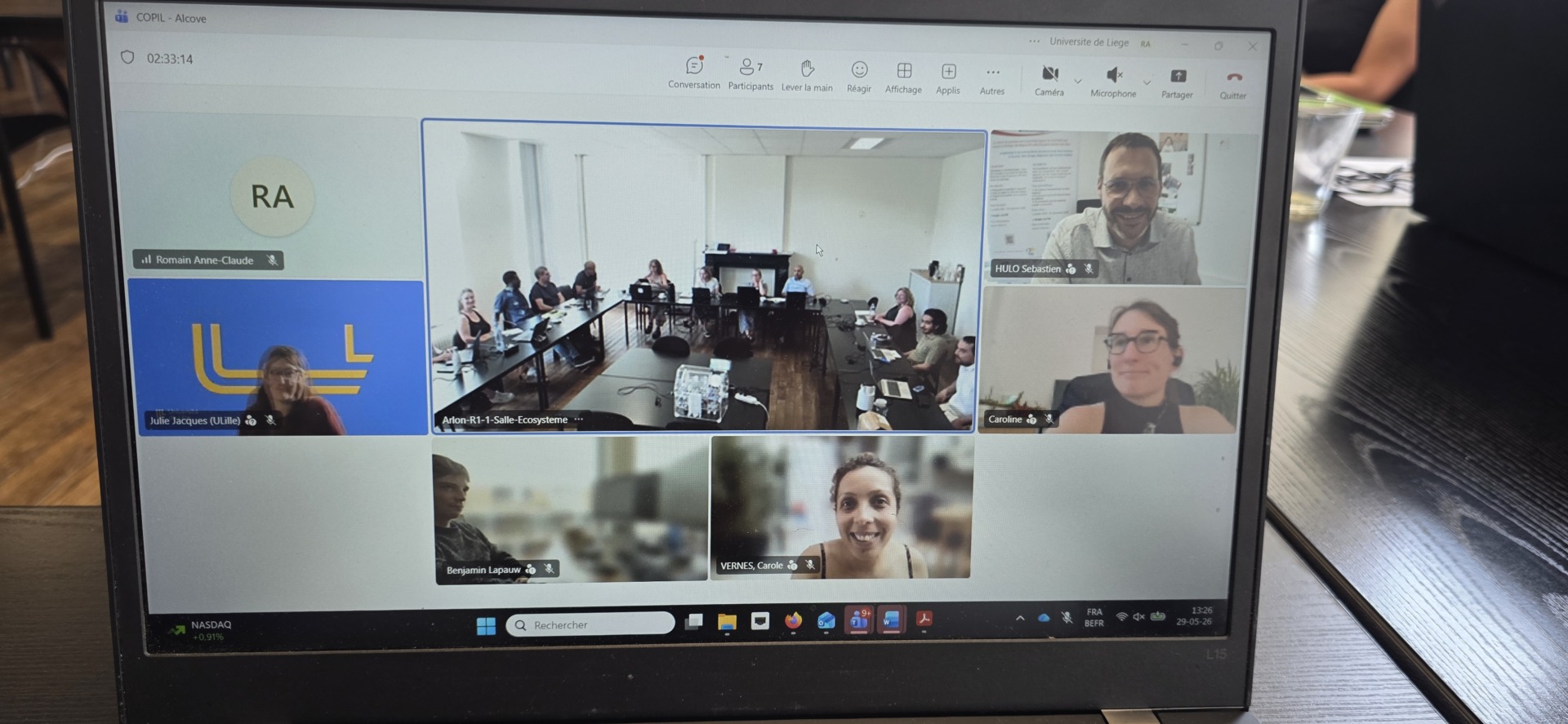
The work package dedicated to management continued its role in coordinating and structuring the project. A significant milestone was reached with the establishment of the first intellectual property committee, bringing together legal representatives from the various partners to lay the foundations for future commercialisation work, particularly regarding issues of confidentiality, prior art and the exploitation of results. Furthermore, the steering committee meeting held in Arlon adopted an innovative format centred on the clinical study, encouraging in-depth discussions between the partners. This period also saw the introduction of initial discussions on capitalising on the project’s achievements and ensuring their sustainability beyond ALCOVE.
WP2 – Communicationand valorisation
The communications work package is continuing its efforts to raise the project’s profile amongst the various stakeholders. A workshop attended by several partners provided an opportunity to update the communications strategy and plan ahead for the project’s upcoming milestones. New tools are currently being developed, including messaging tailored to different target audiences. The visibility of the partners’ scientific work has also been enhanced through numerous appearances at specialist conferences and events. Finally, preparations are continuing for a forthcoming event dedicated to lung cancer, screening and the potential of volatile organic compounds (VOCs) in healthcare, scheduled for 19 November at Lille University Hospital.
WP3 – Clinical trial
The work package dedicated to clinical validation has focused its efforts on preparing the BREATHCODE clinical trial. Several key milestones have been achieved, notably the drafting of the trial protocol, initial discussions with the regulatory authorities, and the gradual finalisation of the device’s technical documentation. Teams from Lille University Hospital, the University of Liège and CIC-IT are also continuing to work together to prepare for the forthcoming regulatory submission. At the same time, the project continues to gain visibility amongst healthcare professionals and the general public thanks to a number of scientific, media and institutional initiatives carried out by the partners.
WP4 – e-nose development
The development of the electronic nose has reached several important milestones with the release of two operational versions of the BRIDGE device. The second version features, in particular, a smaller size, improved temperature control and software enhancements designed to stabilise sensor readings. Initial laboratory tests have begun, whilst the integration of the sensors developed by UMONS, URCA, Materia Nova and IMT Nord Europe is now complete. Work is also focusing on the equipment’s regulatory compliance, the replication of the prototypes and preparations for their future use as part of the clinical trial.
WP5 : Sensor development and optimisation
The partners involved in sensor development are continuing their work on two main families of technologies: resistive sensors and gas-FET sensors. The expected technical specifications have been defined collectively and several miniaturised prototypes have already been manufactured. In Mons, the first metal-oxide-based sensors have been produced and tested, whilst at IMT Nord Europe, research is focusing on organic materials based on polyaniline. At the same time, several projects are aimed at improving the sensitivity of the devices and standardising evaluation protocols in order to prepare for the future phases of qualification and integration into the electronic nose.
WP6 –Data management, artificial intelligence and software
The module dedicated to data and algorithms is simultaneously working on several major projects. Teams at KU Leuven are making progress on defining the data management plan to ensure the quality, security and accessibility of the information collected as part of the project. On the artificial intelligence front, the development of new explainable algorithms is continuing, with scientific findings being presented at international conferences. At the same time, an initial version of the data acquisition system and user interface has been developed. This already incorporates features tailored to clinical and technical applications, whilst meeting the specific security requirements for health data.