

ALCOVE
Lung cancer screening through breath analysis: clinical validation as a decisive step
By validating the effectiveness of the electronic‑nose prototype in a hospital setting, the project aims to make the device fully operational for clinical use in primary care, pharmacies, and routine healthcare facilities.
Context
Lung cancer is currently one of the leading causes of cancer‑related death in Europe, and this is especially true in the Hauts‑de‑France, Grand Est, and Belgium regions. Often diagnosed at an advanced stage, it is associated with a poor overall prognosis, with a 5‑year survival rate of only 17%. However, when patients are diagnosed at an early stage, the 5‑year survival rate can reach 90% thanks to curative surgical treatment.

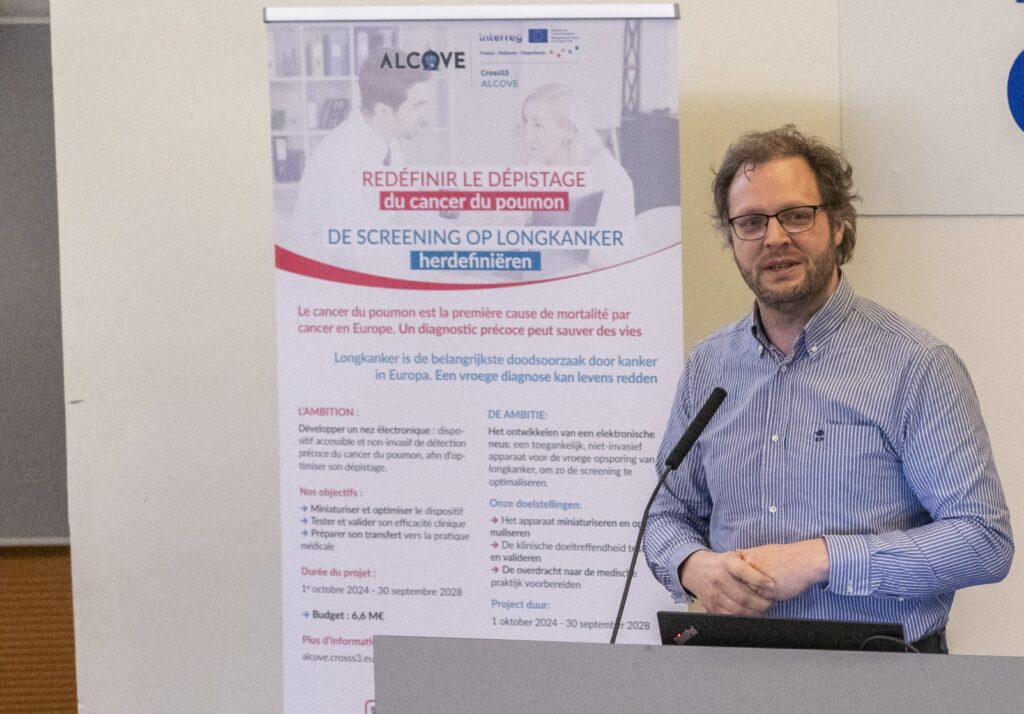
“By facilitating access to simple, community‑based screening, we hope to detect lung cancers earlier and thereby significantly improve patients’ life expectancy.”

Pr Sebastien HULO
Coordinator of the ALCOVE project
at Lille University Hospital

Objectives
The ALCOVE research project aims to validate the effectiveness of an electronic nose — a non‑invasive medical device — in a clinical setting, with the goal of improving cancer screening through breath analysis.
Three strategic objectives of the project:
- Develop electronic‑nose prototypes that meet the requirements of hospital environments in accordance with European regulations.
- Assess the performance of the “electronic‑nose” device in clinical conditions that closely reflect real‑life future screening situations.
- Prepare its integration into future lung cancer screening programmes across the region and support its adoption by healthcare professionals.
6.6M€
budget, including €3.96M from the ERDF and financial support from the Walloon Region
48 month
Project duration for ALCOVE
16 partners
mobilised to successfully carry out the project
9 hospitals
involved in the clinical study in France and Belgium

Key phases
of the project
1
Prototype Production (2024–2026)
Development of prototypes for hospital use, with a focus on optimizing data collection, ensuring data security, and enabling effective processing of information gathered by the electronic nose.

2
Clinical Study (2026–2028)
Assessment of the device’s performance in hospital settings.
3
Dissemination and Valorization (2026–2028)
Communication and outreach actions targeting healthcare professionals, institutions, and the general public, along with efforts to promote the results to industry for potential technology transfer.

A Large-Scale Cross-Border Clinical Study
A clinical study will be conducted involving 492 participants, including patients with operable or inoperable lung cancer, as well as individuals at risk. The study will take place in Hauts-de-France, Grand Est, and Belgium, through the involvement of 9 partner hospitals.
Its objective is to evaluate the ability of the electronic nose to distinguish, in a clinical setting, between at-risk individuals, lung cancer patients, and healthy subjects.

Frequently Asked Questions
Wondering about lung cancer screening, prevention, or how to take part in the ALCOVE study?
This page has been designed to provide simple and clear answers to the most frequently asked questions.
⚠️ Important: this section does not allow you to book an appointment with a healthcare professional.
For any medical or personal request, please consult your general practitioner or a qualified healthcare professional.
If you can’t find the answer to your question, feel free to visit our contact page.
Lung cancer screening is a preventive approach used to look for signs of lung cancer before symptoms appear, specifically in people who are at higher risk. The goal is to detect the disease at an early stage, when treatment is more effective and the chances of recovery are significantly higher.
In health care, prevention refers to all actions aimed at reducing the risk of developing a disease or preventing it from getting worse. This includes measures such as quitting smoking, vaccination, and participating in screening programs.
Lung cancer screening currently relies on medical imaging, particularly low‑dose chest CT scans, offered to individuals who are considered at higher risk.
In France, a pilot initiative called IMPULSION was launched in 2025 to test lung cancer screening in selected regions.
In Belgium, no organized national screening program is in place at this time.
Speak with your doctor to determine whether lung cancer screening is appropriate for you.
Lung cancer is often a silent disease. It can progress for a long time without causing noticeable symptoms. When symptoms do appear, they may include:
a persistent cough,
shortness of breath,
chest pain,
unusual fatigue,
or unintentional weight loss.
In some cases, lung cancer is diagnosed late, after it has spread to other parts of the body.
If you have concerns or notice any of these symptoms, contact a health care provider.
No. The electronic‑nose device is an innovative technology currently being evaluated as part of the ALCOVE clinical study. It is not yet available outside this research setting.
At this time, lung cancer screening relies on medical imaging, specifically low‑dose chest CT scans, offered only in well‑defined clinical contexts.
If you have questions about whether screening is appropriate for you, speak with your health care provider.
Your primary care provider is the first point of contact. They can assess your individual risk factors and, if appropriate, refer you to a center that offers imaging‑based screening, such as a low‑dose chest CT scan, which is used for individuals at higher risk.
The main risk factor for lung cancer is smoking, whether current or past. Other factors may also contribute. Only a health care provider can evaluate your individual level of risk.
Participation in the study is possible by invitation or after referral from a health care provider.
If you meet the eligibility criteria, a partner institution involved in the study may contact you or offer you the opportunity to join the program.
Nine hospitals in the cross‑border region are taking part in the ALCOVE study.
In Belgium (five sites): Gent University Hospital; Helora University Hospital; Institut Jules Bordet ; Leuven University Hospital ; UCL Namur University Hospital
In France (four sites): Amiens–Picardie University Hospital ; Arras Hospital (Groupe Hospitalier Artois–Ternois) ; Lille University Hospital ; Reims University Hospital
Treatment depends on the stage and type of lung cancer. It may include surgery, radiation therapy, chemotherapy, immunotherapy, or targeted therapies.
Care plans are individualized to meet each patient’s specific medical needs.
Screening is a preventive approach performed before any symptoms appear.
Diagnosis occurs when a health care provider investigates the cause of symptoms that are already present.
They talk about us