
An instrument inspired by the human sense of smell
Despite what its name might suggest, an electronic nose is neither a robot nor a futuristic prosthesis. It is a scientific instrument designed to analyse gaseous mixtures using chemical sensors.
Its operating principle is inspired by the human nose:
just as we rely on numerous olfactory receptors reacting to a wide variety of odours, the electronic nose integrates sensors developed by ALCOVE partners.
When a gaseous mixture comes into contact with these sensors, each reacts differently and generates an electrical signal.
All these responses together create a global signature, much like the impression an odour leaves in our brain.
What matters is therefore not the precise identification of every molecule, but the collective pattern created by the sensor network’s responses.
A key role in lung cancer detection
In ALCOVE, the electronic nose has a very specific objective:
determining whether lung cancer is present or absent based on the patient’s exhaled breath.
Human breath is an extremely complex mixture containing a hundred — and sometimes more — different molecules. The challenge is not to analyse each one individually, but to identify a specific signature associated with lung cancer.
The sensors used are not strictly specific — much like human olfactory receptors.
They react to many molecules with varying intensities.
It is precisely the combination of these variations that produces a characteristic pattern, potentially distinct between a healthy person and a person with lung cancer.
A device that must learn before it can discriminate
For an electronic nose to recognise such a signature, it must first learn — a process comparable to how humans learn to associate smells with reliable information.
In ALCOVE, this learning phase relies on exposing the device to breath samples with known clinical status (patients with / without lung cancer).
The sensor responses are then used to build discrimination algorithms capable of identifying patterns associated with the presence of lung cancer.
Once trained, the electronic nose can be used in real‑life conditions:
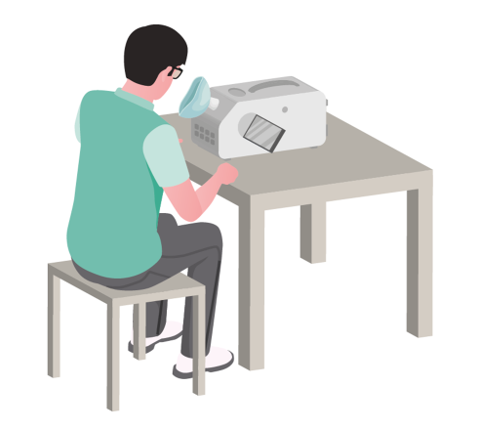
a patient breathes into the device,
a signature is generated,
and the algorithm — the real “brain” of the system — determines whether the profile corresponds to that associated with lung cancer.
This approach does not replace standard diagnostic tools, but aims to provide a non‑invasive, rapid and accessible method that could help guide screening pathways more efficiently.
A technology at the crossroads of multiple challenges
Developing a reliable electronic nose involves overcoming several challenges:
- designing a reproducible instrument — 11 identical devices will be used in the clinical study;
- ensuring the sensitivity, stability and consistency of the sensor array;
- securing the collection and processing of medical data;
- adapting the device to hospital use, with its strict quality and safety requirements.
This is precisely the strength of the ALCOVE consortium: bringing together, around a shared objective, experts in sensors, instrumentation, clinical research, signal processing and data security.