

The teams are making significant strides across every component of the ALCOVE project. Here is a concise overview of recent progress to maintain a clear and shared vision of our collective advancement.
Work Package 2 – Communication: solid foundations and growing visibility
The foundations of the communication strategy have now been established around four key priorities, identified based on consortium feedback:
raising awareness about lung cancer screening,
showcasing multidisciplinarity,
engaging healthcare professionals,
and stimulating interest from industry.
Several tools have already been created and shared:
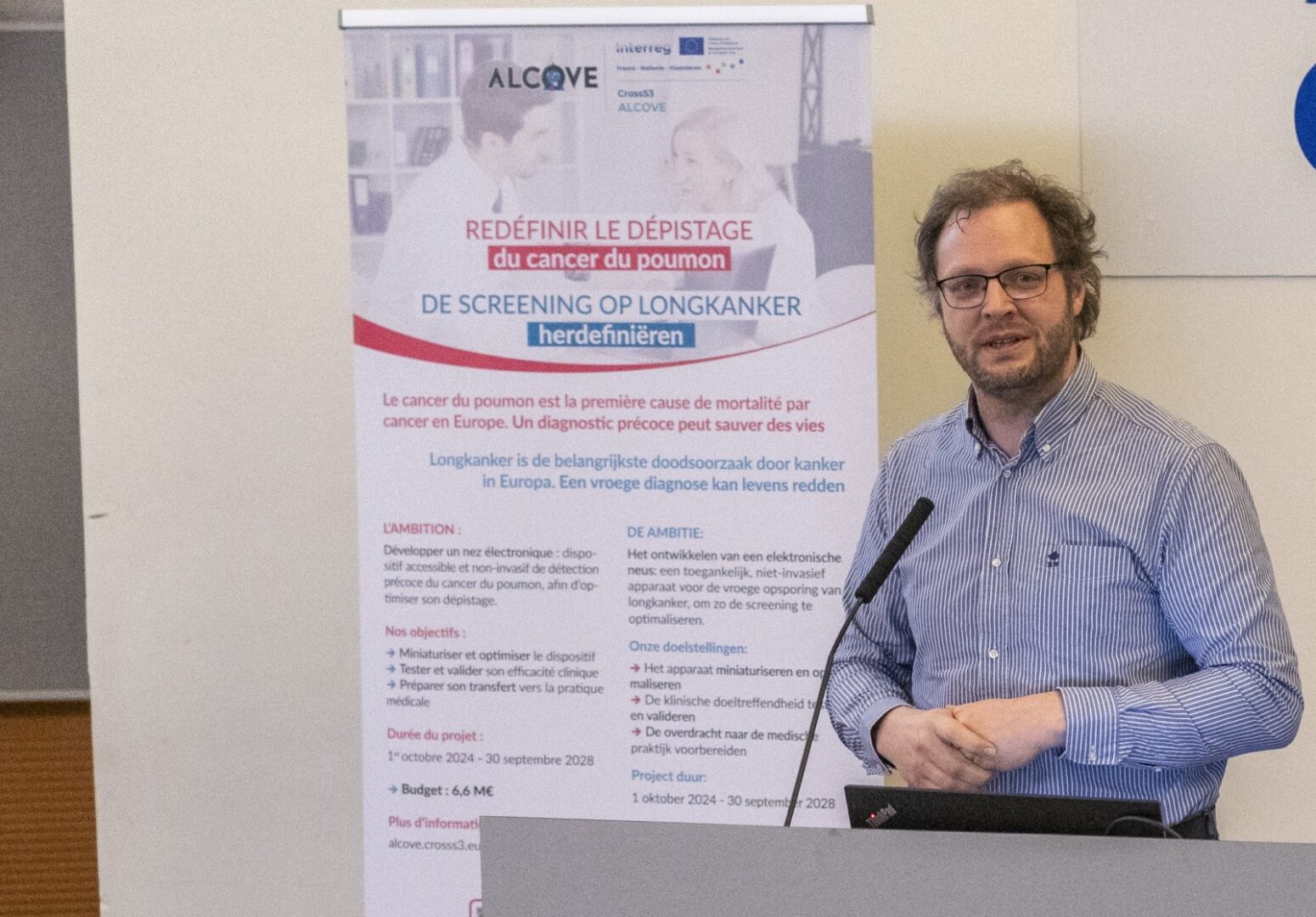
the first newsletter, a dedicated LinkedIn account, shared document templates, and a common roll-up banner.
The website is currently being finalised.
A first press campaign, organised during the launch event in Lille, generated extensive media coverage in both France and Belgium. Notably, partner engagement was particularly strong, especially in the production of audiovisual content through interviews and media reports supported by their active participation.
Work Package 3 – Clinical Study: towards a shared and robust protocol
On 10 December 2024, WP3 partners met to collectively advance the organisation of the ALCOVE clinical study: study design, logistics, participant recruitment — all key aspects were addressed.
In parallel, CHU de Lille, as study sponsor, is coordinating regulatory preparations in close collaboration with WP4 and WP6 teams. Recommendations are being shared with technical teams (OP2 and OP11) to ensure that the electronic nose prototype meets essential requirements for safety, ergonomics, functionality and real‑world usability.
The clinical investigation team has met twice a month to co‑build the study synopsis, which is now in its finalisation phase and has recently been submitted to the Clinical Studies Promotion Department at CHU de Lille. This department will handle submissions to French regulatory authorities and coordinate with the Jules Bordet Institute (promotion delegated for Belgium).
This work includes:
reviewing key scientific publications,
integrating feedback from clinical partners,
defining the statistical analysis plan,
and preparing the electronic Case Report Form (e‑CRF).
Work Package 4 – A pre‑series prototype in production
The University of Liège has carried out intensive work on developing the electronic nose prototype ahead of clinical testing. A series of coordination meetings were held with WP5 and WP6 to align technical requirements — online on 15 November and 11 December 2024, and then in person in Arlon on 27–28 January 2025 for a modelling presentation with CHU de Lille, CIC‑IT, and Belgian partners.
Continuous dialogue with WP3 clinicians enabled early adjustments to the prototype. Structured feedback from clinicians and hygiene teams, based on modelling, was shared on 18 February. Following this, a first version of the prototype entered production at the University of Liège.
A patent application process has also been initiated with the ULiège legal department to protect the device and support its future transfer to industry.
Work Package 5 – Towards sensitive and miniaturised sensors
WP5 partners have worked closely with WP4 to define the geometric and electrical specifications of the sensors integrated into the electronic nose.
The goal: ensure compatibility and uniformity across sensors developed by UMONS, Materia Nova, and IMT Nord Europe. These specifications were consolidated during a meeting in Arlon.
UMONS has begun fabricating first‑generation sensors based on metal oxide sensitive materials.
The long and meticulous synthesis process allows fine control of material morphology to enhance sensitivity and selectivity.
Sensor miniaturisation is carried out by Materia Nova:
sensitive layers are screen‑printed onto a substrate of around 2 mm²,
the substrate is suspended using gold wires inside a TO‑header housing, ensuring mechanical protection and electrical interfacing.
A formal agreement has been signed with a subcontractor to ensure small‑series manufacturing.
In parallel, partners are investigating the transistor effect to amplify sensor signals.
The University of Reims is designing and fabricating organic and inorganic thin‑film transistors for VOC detection, in collaboration with MT5 partners. Recent progress includes:
- reducing operating voltages by optimising the gate insulator;
- designing and producing a mechanical and electrical adaptor to measure transistor responses to VOCs at IMT Douai;
- adapting transistor technology to this system (including a metal deposition step);
- delivering the first treated substrates to Materia Nova for metal oxide film deposition before final transistor fabrication in Reims.
A qualification bench has been implemented by IMT Nord Europe to assess sensor performance under controlled climate conditions.
Comprehensive tests, conducted at ULiège, will validate first‑generation sensor performance in conditions close to their final use.
Work Package 6 – Interface, secure data transfer and software processing
The MT6 partners have focused their efforts on three essential areas for the operational implementation of the electronic nose:
the Data Management Plan (DMP), the secure transfer of data, and the development of the user interface.
In a first step, the requirements for a DMP compliant with the expectations of the Interreg programme were analysed.
A first version of the plan has been drafted using the DMPonline.be platform.
The next steps will consist in contacting the clinical partners in order to gather precise information on:
the types of data generated,
where they are stored,
how they are stored,
and under what access conditions.
At the same time, several meetings have been held to discuss the procedures for secure data transfer.
While waiting to finalise the technical and legal requirements, a temporary solution based on local, physical data storage has been selected so as not to delay the launch of the measurement campaigns.
The user interface of the electronic nose has also seen its first developments.
An initial version was created using the Godot game engine, which is compatible with several platforms (Windows, Android, macOS).
This application allows users to access data via personalised passwords.
A functional mock‑up was implemented on the Bruges campus, in order to develop and test Bluetooth connectivity before integrating it into the final device.
In parallel, ULiège has continued the development of an interface software tool enabling developers to communicate with the electronic nose.
Through Bluetooth, this software makes it possible to retrieve sensor measurements and import them into a software application.
This system will serve as the basis for the mobile application developed by KU Leuven as part of its activities.